Tag Archives: Great Commission

Sacred Signs of Subversion, Part 1: The Sign of the Cross

Read Matthew 28:18-20

ALSO IN SCRIPTURE
“For I am not ashamed of this Good News about Christ. It is the power of God at work, saving everyone who believes…” (Romans 1:16 NLT)

Symbols carry memory and meaning far beyond words. The Church has always leaned on them—sometimes hidden in plain sight, sometimes dismissed or distorted. Yet the most powerful symbols are those that subvert the world’s expectations and draw us back to the radical heart of the Gospel. In this series, we’ll look closer at the sacred signs that shock, unsettle, and ultimately call us deeper into Christ.

Image: AI-generated using DALL·E (OpenAI) and customized by the author. Used with the devotional “Sign of the Cross” at Life-Giving Water Devotions.

Part 1: Sign of the Cross. From the earliest days of the Church, Christians marked themselves with the cross. Tracing forehead, chest, and shoulders was a prayer in motion—a way to remember baptism, to claim protection in Christ, and to show where their allegiance lay. To sign yourself with the cross in the Roman world was risky; it announced to all that you belonged not to Caesar but to Christ. In times of persecution, when even a whispered prayer could invite danger, the sign of the cross was a visible act of courage. It reminded believers that their lives were not their own—they had been bought with a price.

There is also the sign a pastor or priest makes when blessing others, with three fingers pressed together to proclaim the Trinity and two bent down to confess Christ’s dual nature. That gesture is catechesis in motion—doctrine written into the very hand, tracing the cross outward as blessing. The Church used symbols like this not just for decoration but for teaching; the faithful learned the deepest truths of Christianity by what they could see and touch, even if they could not read. Both forms, whether made by the believer or bestowed by a minister, carried deep meaning: allegiance to Christ, confession of faith, and blessing in his name.

And yet, many of us—especially in Protestant traditions—abandoned these signs. We dismissed them as “too Catholic,” “superstitious,” or “empty ritual.” But that was ignorance. In casting them aside, we lost not only symbols that connect us to our baptismal identity, but also a gesture that taught the mystery of our faith in body and hand. What was once a radical embodied witness was reduced to a ritual caricature—or forgotten altogether. The loss has left our faith poorer, more disembodied, and less connected to the practices that once grounded everyday discipleship. Christianity became increasingly intellectualized, treated as a set of beliefs to agree with rather than a way of life to embody.

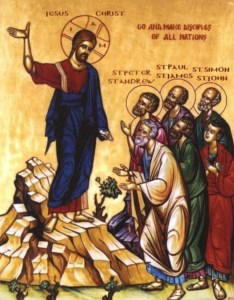
This is why the connection to Matthew 28 is so important. When Jesus sent his disciples out with the Great Commission, he commanded them to baptize “in the name of the Father, and the Son, and the Holy Spirit.” The sign of the cross is, in many ways, a miniature act of that Great Commission. To trace the cross over yourself or others is to confess the Trinity, to remember your baptism, to place yourself under Christ’s authority, and to carry his promise—“I am with you always, even to the end of the age.” It is the Commission embodied in a single gesture.

That is why I have reclaimed the practice in my own life and ministry. I make the sign of the cross in worship, I trace it in blessing, and I use it in quiet moments of prayer. Each time, I am reminded that I am marked as Christ’s own, confessing both the mystery of the Trinity and the dual nature of Christ. Embodied practices matter because they root faith in daily life; they keep us from reducing Christianity to abstract ideas or empty slogans. When I trace the cross over someone during a blessing, I am not performing a quaint ritual. I am declaring that they, too, are beloved of God, sealed with Christ’s promise, and carried in the Spirit’s care.

In a world that constantly tries to claim us—through nationalism, consumerism, or ego—the sign of the cross is a small, defiant act of faith. It is a refusal to bow to lesser gods. It is a prayer that says my body, my spirit, and my future are not for sale. And it is a blessing that pushes back against fear, reminding us that Christ has already claimed the final word. What looks like a simple gesture becomes, in truth, a radical proclamation: Jesus Christ is Lord.

THOUGHT OF THE DAY
The sign of the cross—whether traced on yourself or offered in blessing—is a subversive act that reclaims your identity as Christ’s own.

PRAYER
Lord Jesus, you claimed me in baptism and sealed me with your Spirit. Help me to reclaim the sacred signs of faith, not as empty ritual but as radical witness. May my body, words, and life bear the mark of your cross, today and always. Amen.


Devotion written by Rev. Todd R. Lattig with the assistance of ChatGPT (OpenAI).

God’s People, part 153: New Moses

Read Matthew 5:1-20

ALSO IN SCRIPTURE
“You have heard the law that says the punishment must match the injury: ‘An eye for an eye, and a tooth for a tooth.’ But I say, do not resist an evil person! If someone slaps you on the right cheek, offer the other cheek also.”  (Matthew 5:38-39, NLT)

When we think of God’s people, we tend to think one of two things. We might think of the Israelites who were God’s “chosen people”, or we might think of specific characters in the Bible. Either way, we tend to idealize the people we are thinking about. For instance, we may think that God’s people are super faithful, holy, perform miracles and live wholly devout and righteous lives. Unfortunately, this idealism enables us to distance ourselves from being God’s people, because we feel that we fall short of those ideals. As such, I have decided to write a devotion series on specific characters in the Bible in order to show you how much these Biblical people are truly like us, and how much we are truly called to be God’s people.

Part 153: New Moses. In Mark, we learn that Jesus true identity was revealed through his suffering and death on the cross. It was in that moment that the Roman Officer, who was an outsider to Judaism and was the one overseeing Jesus’ crucifixion, was the only human being in Mark’s Gospel who realized Jesus’ identity as the Son of God. The only other place in that Gospel that we see that title being used is at the very beginning when Mark declared it to his audience. Every other human fails to realize it. The only other beings who seem to know who Jesus is are the demons. Flattering, right? It’s no wonder that Jesus was frustrated from chapter 4 onward.

While Mark’s account was written to a predominantly Gentile community, Matthew’s Gospel is written to Jewish followers of Jesus. Thus we do not see Matthew explaining what every Jewish custom was or what certain Aramaic phrases are because, unlike Mark’s community, his community would have understood those things. Instead, because of his context, Matthew focused on connecting Jesus to the Old Testament. Thus, he starts his Gospel with Jesus’ lineage, which traces back through King David to Abraham.

More importantly, Matthew show Jesus to be the New Moses. Just as Moses came out of Egypt, Jesus came out of Egypt following him fleeing there with his parents as refugees. Just as Moses passed through the waters of the Red Sea, Jesus passed through the waters of the Jordan at his baptism. Just as Moses led the Israelites through the wilderness for 40 years, Jesus was in the wilderness and was tempted for 40 days. What’s more, just as Moses received the law from God on the mountain, Jesus gave the law from his sermon on the mount.

With that said, Matthew was not merely comparing what Jesus did to what Moses did, as if Jesus was just some sort of uncanny Mosaic doppelgänger; rather, Matthew was showing that Jesus was actually greater than Moses. Moses may have delivered the Israelites out of slavery from Egypt, but Jesus delivers all of humanity from slavery to sin and death. While Moses gave the Law to the Israelites, Jesus gave us new divine teaching that not only gave deeper insight to the heart of the Law of Moses, but that profoundly revealed that the Law not only pointed to him, but also to the opening of the covenant to all people.

Jesus, in Matthew, was not only the New Moses, but was the only one who was righteously poised to judge the world. Yet, instead of judging the world, he was judged on their behalf. Matthew shows us that Jesus was the Suffering Servant prophesied about in Isaiah 53. He came not to judge but, instead became “a ransom for many” (Matthew 20:28). Jesus’ glory is not merely revealed through the cross, but in divine birth, his fulfillment of prophecy, the breadth of his life, the authoritative scope of his teaching, the pain he endured, the punishment he suffered that led to his death, and the resurrection.

Matthew challenges us to come face-to-face with the King of kings, who is Immanuel (God with us) for all time. Will we humbly bow before our King? Will we accept his divine teachings and follow them intently? Will we trust in his ability to save us from our sinful humanity? Will we follow him, even if it means dying on a cross like he did (Matthew 16:24)? If we answer yes to that question then we MUST take seriously Christ’s teachings and follow his great commission found in Matthew 28. Let us all follow Christ, by the power of the Holy Spirit, who is Lord of all!

THOUGHT OF THE DAY
“I have been given all authority in heaven and on earth. Therefore, go and make disciples of all the nations, baptizing them in the name of the Father and the Son and the Holy Spirit. Teach these new disciples to obey all the commands I have given you. And be sure of this: I am with you always, even to the end of the age.” – Jesus Christ  (Matthew 28:18-20, NLT)

PRAYER
Lord, I want to be a Christian in my heart. Help me to be your follower. Amen.