Category Archives: Previous Post

REVISITED: The Christian Manifesto

Read Isaiah 61:1-3; Luke 4:14-30

ALSO IN SCRIPTURE

“Thus says the Lord GOD: Enough, O princes of Israel! Put away violence and oppression, and do what is just and right. Cease your evictions of my people, says the Lord GOD.” (Ezekiel 45:9)

The Christian ManifestoOkay, I’ll be the first to admit that the over-commercialization of Christmas can be sickening. I mean, there we were walking down the aisle of our local department store looking for costumes and goodies for Halloween and I saw workers ’round the corner setting up their Christmas displays…and this was the beginning of October!!! What is up with that!?!? Pretty soon it will be Christmas in July!

With that said, now that Halloween has passed I have started to feel those warm and fuzzy feelings that tend to come as the holidays (Thanksgiving, Christmas and New Year’s) are approaching. Just this afternoon I was listening to my iPod while driving and I happened to see that I had David Phelps on it, so I went to his album and chose to listen to his rendition of my favorite Christmas song ever: “O Holy Night”.

If you have never heard David sing O Holy Night, let me tell you that you need to stop reading this now and listen to it. For those who are reading this devotional online, I have included a link to the video of David performing it live (go to about 1:14 in the video to skip the intro…and never mind the televangelist-esque feel to the video…his voice is totally worth it). As I was listening to this man belt out the song with heart and emotion and one of the best voices I have ever heard sing the song, I began to have a revelation of the true meaning of this song. While “O Holy Night” is certainly a Christmas song, there is no doubt that its message is one that should be sung in our hearts all year-long.

The third verse captures what I believe to be the heart of Christianity: “Truly He taught us to love one another; his law is love and His gospel is peace. Chains shall He break for the slave is our brother; and in His name all oppression shall cease. Sweet hymns of joy in grateful chorus raise we, let all within us praise His holy name.” If we learned nothing else of Christianity, let it not be said that we did not learn this–that Christ’s law is love and his Gospel is peace. Let it not be said that we failed to  learn, as Christians, that in Christ’s name all oppression should cease!

In Luke 4:18-19, Jesus made it very clear that he was anointed by God “to bring good news to the poor…to proclaim release to the captives and recovery of sight to the blind, to let the oppressed go free, [and] to proclaim the year of the Lord’s favor.” If this was Jesus’ mission, and if we are his resurrected body carrying on his work and mission in the world, then doesn’t it go without saying that Luke 4:18-19 should be our manifesto, our mission, as well?

Christians have argued whether or not Jesus was focused on social or spiritual matters; however, I believe that Jesus was focused on both and that the two cannot be so easily disconnected. How can we be sound spiritually if we are not sound socially? How can we be sound socially if we are not sound spiritually. Too often the West has tried to compartmentalize the human being, and it has come at great peril. Rather than deny one for the other, let us embrace the fact that Christ has called us to live each moment of our lives with the same passion for God’s mission as David Phelps has in singing O Holy Night. Let us live our lives in a way that reflects the hope, the healing and the wholeness of God! Remember, Christ’s law is LOVE and his Gospel is peace…in Christ’s name all oppression (Spiritual, emotional, physical, social, and psychological) shall cease!

THOUGHT OF THE DAY

“It is impossible to enslave, mentally or socially, a bible-reading people. The principles of the bible are the groundwork of human freedom.” – Horace Greeley

PRAYER

Lord, you have called me to bear Christ’s name. His mission is my mission; help me to have the courage to stand up against all forms of oppression, regardless of the cost. Amen.

REVISITED: Ixnay the Cliché

Read Micah 6:1-15

ALSO IN SCRIPTURE
“Hate evil and love good, and establish justice in the gate; it may be that the LORD, the God of hosts, will be gracious to the remnant of Joseph.” (Amos 5:15)

highway-to-glory

The end justifies the means. That is a cliché that I think is predominant in our society and/or culture. The end justifies the means. All we need to do is turn on television and watch any of a plethora of television shows, all we need to do is to go to the theater and watch any given movie and we will see a whole lot of that cliché being played out. We see heroes compromising their values in order to bring about some supposedly better end…and using any means necessary to make that happen.

Beyond television shows and movies, politicians will often use any means necessary to bring about what they believe to be a better end. Politicians who cut people down and use political action committees to destroy the reputation of their opponents, simply because they believe they’d make the best leader. Businesses who look at the bottom dollar as the end goal and use whatever means necessary in order to make the bottom dollar work out in favor of the company. Often times, the means to attain that end involves coldly getting rid of people and treating employees as expendable numbers, rather than being compassionate and not treating people as if they are expendable.

We also see this cliché play out in our communities. We see our government take people’s homes and property away, declaring it as eminent domain, in order to better commercialize and bring more money into a town and/or region. We see people who will cut people off on the road to ensure they’re not going to be late getting to work, or to a play, or to the nearest roadside coffee shop. I have even witnessed people cutting around funeral processions in order to avoid getting stuck in those situations.

The point here is this, in order to live by the cliché of “the end justifying the means,” we have to ultimately compromise our character and our moral code. The cliché certainly, and explicitly, announces that. The end justifies the means. That is really a nice way of saying the following: while normally taking this action would be deemed bad and/or immoral, it is okay to do so here because, in the end, things will work out for the better. The end justifies the means. Whatever means it takes to reach the end is justified by virtue of the end that is trying to be reached.

The end justifies the means…or does it? When we look to Scripture we see a ton of examples as to how the end never, ever justifies the means. David is, perhaps the most compelling and obvious of people to look at in this regard. David would do just about anything to be king, and once he became king he did just about anything to keep himself and his family in power. He slept with Bathsheba and to avoid scandal had her husband killed. He offed his political rivals with shrewd and shady expediency, looking as if he had nothing to do with it. He knew he was God’s chosen king and that God was going to establish his kingdom forever, and he let that go to his head. As a result his kingdom, his reputation, his power, and his entire family came crashing down.

Not only does the end never justify the means, the reality is that often times the means changes and/or destroys the end. What’s more, the means changes and/or destroys us in the process. Let us not be a people who justify any and every means to reach an end. Let us not be a people who justify evil by the end we are trying to reach. Remember that our call, first and foremost, is to live justly, love mercy, and walk humbly with God, regardless of the end. In fact, there should be no other end but that, and that end will dictate the means. Live justly, love mercy, walk humbly. It’s simple, it’s honest, and it’s the narrow way that leads to God’s Kingdom.

THOUGHT OF THE DAY
“In everything do to others as you would have them do to you; for this is the law and the prophets. “Enter through the narrow gate; for the gate is wide and the road is easy that leads to destruction, and there are many who take it. For the gate is narrow and the road is hard that leads to life, and there are few who find it.” – Jesus, the Christ (Matthew 7:12-14)


PRAYER
Lord, I want to follow you in all that I do. Lovingly hold me accountable to your way and steer me clear of sin and evil. Amen.

REVISITED: The Categorical Imperative

Read Genesis 1:26-31; Psalm 23; Matthew 25:31-46

ALSO IN SCRIPTURE
“Moreover, it is required of stewards that they be found trustworthy.” (1 Corinthians 4:2 NRSV)

In the church and in the corporate world, the word “stewardship” often floats around congregations in the form of campaigns to raise “funds” for the mission and ministries of the church. As such, many people hear the word “stewardship” as just a church-speak for, “cough up some dough for us.” This particular perception has risen up as a result of the way stewardship has been discussed and handled in the church and corporate settings.

Yet, the word steward is used in other ways that point to the fact that, deep down, we know stewardship to be more than just monetary support. Back in the day, flight attendants were known as Stewards and/or Stewardesses. The steward, in the airline industry, is the person who cares for the needs of the customers boarded on the plane. They fetch pillows, bring food and drink, listen to and address issues specific travelers may be having, and they instruct people of safety procedures in case of an emergency. What’s more, in the event of an emergency, the steward risks their own safety in order to save lives and get people off of the plane (if it has been grounded). The role of a steward is the same on trains and ships as well.

There are other examples of stewardship as well. Rather, than belabor the reader with a million examples of stewardship, it is more important to point to the definition of what a steward is, in order to better grasp the concept of stewardship. A steward is a person how cares for the needs of other people, organizations, events, and/or places. Thus, stewardship is the ethos that embodies the responsibility of caring for those needs, which absolutely includes the management and planning of resources. With that said, let us not simply limit resources to money. Google defines a resource as, “a stock or supply of money, materials, staff, and other assets that can be drawn on by a person or organization in order to function effectively.”

In other words, stewardship is the embodiment of managing and planning resources, whether those resources are monetary, material, human, natural, or any other resource. Being a good steward is about managing those resources well; however, this sounds more corporate and less spiritually worded. In terms of being Christian and living out our Christian faith, being a good steward means taking good care of all that God has given us and making proper use of the resources God has given us. If we don’t share our resources with others, we are not being good stewards, and the same is true if we neglect, abuse, misuse, or mismanage the resources shared with us.

Thus, to be a good steward, spiritually speaking, we must recognize that ALL THINGS are FROM GOD. Our money, our natural resources, our real estate and property, our congregation members (in the case of churches), our staff members (in the case of corporations and/or organizations), and all other resources are from God. If we do not recognize the divine value within each of the non-living resources, and the divine presence and/or image in all living resources (especially in humans), then we are not embodying the ethos of good Stewardship. We cannot abuse/neglect the environment, be misers, and/or see our congregation members, our staff, our friends and family as expendable means to an end, and still call ourselves good stewards, let alone stewards in any sense of the word.

This latter part is often overlooked in stewardship talks and campaigns and, yet, is the most important part of stewardship. PEOPLE MATTER and are to be valued. LIVING BEINGS are ends unto themselves and never should be seen as a means to an end (to summarize Immanuel Kant’s Categorical Imperative). So, today I challenge you to start evaluating your stewardship and start working toward being the best stewards you can be. That is what it means to be disciples of Christ, that is what it takes to truly follow Christ and uphold Christian values. STEWARDSHIP IS VITAL. Be good stewards and work to user in God’s Kingdom on Earth.

THOUGHT OF THE DAY
“Live your life as though your every act were to become a universal law.” – Immanuel Kant
PRAYER
Lord, forgive me for when I’ve used people as a means to an end. Help me to treat people as divine persons and not tools. Amen.

REVISITED: I WILL BE

Read 2 Samuel 7:1-13

ALSO IN SCRIPTURE
God said to Moses, “I [WILL BE] WHO I [WILL BE].” (Exodus 3:14)

foZt7gK

Limited. If there is one word I can come up with when thinking about human beings, it is “limited.” We are limited in our perceptions, limited in our abilities, limited in our vision, and limited in just about every other aspect of our being. This is not a negative judgment, but rather an observation. In our minds, we love to imagine ourselves as being limitless. We watch TV shows and movies about superheroes who seem to be unlimited in their abilities, heroes who can literally fly to the moon and back in a single bound.

Yet, our reality is far different from the ideal we hold in our heads. The truth is that, as much as we would love to not have limits or bounds, we are totally limited. We are limited in our physical abilities, our psychological abilities, and we are limited emotionally as well. While all of this seems pretty pessimistic, and I am sure you are wondering what kind of point I could possibly be leading up to in this dour opening to a reflection, the truth is that this is not pessimistic. In fact, it is neither pessimistic or optimistic; rather, this is realistic.

What’s more, not only are we naturally limited in our capabilities but we limit ourselves in ways we should not be limited. While this is the case in a wide range of things, and across a wide range of people, I want to focus on Christians. While we are called to be a people of faith, we limit ourselves by our fear. We allow our fears to take over in our lives and we make them our lord rather than following our true Lord and Savior. We limit our understanding and conception of God as well. We build up church institutions, create polity to govern and control them, raise up church buildings, and fill those buildings with people. Over time, the people get so caught up in the institution, the polity, the buildings and their own little cloistered community that they end up limiting God to their own time, place and context.

In other words, they try and box God in. That’s not to say that God is actually boxed in or that God is actually limited; rather, it is people’s perceptions of God that are limited. This is nothing new, David wanted to box God in when he wanted to build God a house. God’s response to David was this: “Do I need you to build me a house? Am I not the God who created the world and all that is in it? Am I not the God who wandered with my people through the wilderness without any temple or house to live in? Do I really need a home? No, David! You will not build me a house.”

God WILL NOT be boxed in. Up on Sinai, when Moses asked who he should tell had sent him to free the Hebrews, God responded by saying “I AM WHO I AM. Tell them that I AM has sent you to them.” That phrase, “I AM WHO I AM”, can in Hebrew also be translated as “I WILL BE WHO I WILL BE.” God’s message to Moses, and to us as well, is that GOD IS. That God is with us, that God is always present with us. I AM WHO I AM. On top of that God is also reminding us, perhaps even warning us, I WILL BE WHO I WILL BE.

We cannot box God in. We cannot contain God and we can not have control over who God is or how God will manifest in the lives of others. Are you boxing God in? If so, in what ways? I challenge you to ask yourself those questions. Wrestle with them, for God wants you to trade in your perceptions for the reality and the universality of God’s presence and God’s love. GOD WILL NOT BE BOXED IN. The only house God wants to reside in is our hearts. I pray that, if you haven’t already, you open your hearts to the GOD. I pray that you are filled with the great I AM WHO I AM and that you are opened to the limitless possibilities of a God who WILL BE WHO GOD WILL BE.

THOUGHT OF THE DAY
Boxes are square or rectangular, have a beginning, an end, and are not infinite or eternal. God is not a box; rather, God is a circle of which has no beginning, no end and is both infinite and eternal.

PRAYER
Lord, help me not to limit who you are in my life or in my world. You are the great I AM, as well as the great I WILL BE. Amen.

REVISTED: I AM

Read Exodus 3:1-14

ALSO IN SCRIPTURE
“I assure you,” Jesus replied, “before Abraham was, I Am.” (John 8:58 CEB)

i-am

One of the most powerful stories in all of the Bible, for me, is the story of Moses and the burning bush. While the concept of a bush that is on fire but not consumed is pretty cool in and of itself, but that miracle is not what draws me to the story. It is also pretty awesome that a voice is coming from this burning bush, but that is not what draws me in. I mean sure, that would be pretty powerful to witness, at least in the moment. It might even be powerful and remain cool the next couple of days; however, overtime it would end up getting stored on the back shelves of cool things in my mind, right along with sightings of ghosts, my first kiss, and other such things.

As we know, Moses was tending sheep at the base of Mount Horeb (aka Mount Sinai) when he looked up on the mountain and saw an odd flickering light. It looked to him like a fire and, like most people would, Moses went up on the mountain to check it out. Upon reaching the flickering light, he noticed that it was a bush that was totally caught up in flames, but wasn’t actually burning. In fact, it is kind of ironic that this bush became known as the “burning bush” because it wasn’t burning at all. Naturally, and probably cautiously, Moses began to step closer and closer to the bush. As he approached it, a voice cried out from the flames, “Moses, remove your sandals for you are standing on holy ground.” Now, I don’t know about you, but if I heard that I would have thrown myself off the mountain in fear. Moses was far braver than I and he did as the voice instructed him.

To make a long story short, and so as to not completely repeat the story you already just read in your Bible or e-Bible, Moses ended up having a complete conversation with this disembodied voice emanating from the not-so-burning bush. This voice told Moses that he was the voice of God and that it wanted Moses to carry out a very important task: to go back to Egypt and meet with Pharoah, telling him to let God’s people go. Moses tried to turn down God’s call, but to no avail. Finally, after Moses realized that God had convinced him to go, he asked, “Who should I tell my people sent me when they ask?” God’s answer is what, for me makes this one of the most powerful stories. God replied, “I AM WHO I AM. Tell them I AM sent you.”

Now, on the one hand, that must have thrown Moses for a loop. How could Moses even consider that an acceptable answer? Would people really get what he meant when he said “I AM” has sent me to you, let alone believe him? Yet, Moses carries that message to the Hebrew slaves, “I AM” has sent me to you. What is powerful about that is that it fundamentally shows us who our GOD is. Our God is our I AM. God is always with us, present with us in all of our struggles and trials. Our God is always with us, celebrating with us in our joys and triumphs. Our God is the great I AM. There could never be any greater hope than the hope of God’s presence with us.

From this account of God’s eternal presence comes a powerful message for us. If our God is the great I AM, and if we are the children of God, then it follows that WE ARE. Each and every one of us ARE. We have been created to celebrate the I AM within us. We have been created to live and to live abundantly. We have been created to BE, and celebrate our BEING. Do you do this? Do you celebrate who you are? Do you celebrate the divine I AM that resides in you? Do you see yourself as a child of the great I AM? Today’s challenge, and really everyday’s challenge, is this: look at yourself in the mirror. Stare into your own eyes. Stare deeply, get lost in the iris sea and peer into your soul. When the moment feels right, I want you to say the following words out loud to yourself: “I AM.” Seriously, look yourself in the mirror, get to know yourself and tell yourself, “I AM.” Then, go out into your day, everyday, and see the divine I AM in others. In that I AM will set you and others free.

THOUGHT OF THE DAY
“I am what I am. I love me! And I don’t mean that egotistically – I love that God has allowed me to take whatever it was that I had and to make something out of it.” – Stevie Wonder

PRAYER
Lord, I am because YOU ARE. Thank you for making me who I am and help me to fully realize who I am. Amen.

REVISITED: The Gospel Truth

Read Luke 20:9-19

ALSO IN SCRIPTURE
“
He replied, ‘My mother and brothers are those who listen to God’s word and do it.’” (Matthew Luke 20:9-19 CEB)

copy-of-jesus-face

If I were to walk into any given church, or up to any random person, and ask them what the heart of the Gospel message is, I would more than like receive something like the following: “The Gospel message is that God sent his one and only Son, Jesus Christ, into the world so that he could be the perfect sacrifice for our sins. Because Jesus was perfect and without sin, he became the spotless lamb led to the slaughter in order that he may die the death we deserve in order that those who believe in him might be atoned to God and saved.” This is the, in essence, the modern, popular Christian understanding of the heart of the Christian Gospel. Jesus came to die so that we might live.

Yet,  when you read the Gospels themselves, we find that Jesus dying as a sacrifice for our sins is just a part of the Gospel story. It is not the whole of it. Yes, Jesus’ death and resurrection are vitally important to Christian theology, Christology, and the Gospel message; however, only so when it is told in the context of the other components that we find in the Gospel. When those components are missing, what we end up is with a skewed, inaccurate portrait of the purpose of Jesus of Nazareth, as well as a skewed and inaccurate portrait of God’s purpose for sending Jesus, the Christ.

While it is certainly true that Jesus’ death and resurrection has brought about salvific and transformative atonement from our sins, to only tell that part of the story does an injustice to the life and the teachings of the Christ. In fact, it not only does a disservice, but it completely ignores Jesus’ life and teachings altogether, as if they are simply secondary and/or non-important. Yet, was Jesus’ life and teachings trivial? Was his life and teachings secondary, just a necessary back-story to his ultimate death and resurrection? If that is the case, if Jesus’ teachings are trivial and secondary to the work of salvation in the world, then why go down the route of teaching and preaching at all. The Gospel writers could have simply just had Jesus proclaim that his the messiah and the son of God, have people reject that, have him crucified, died, buried, resurrected and be done with it.

But that is not what the Gospel writers did. Rather, they included the whole of Jesus’ life and they dedicated most of their time on Jesus’ teachings. For them, the person of Jesus of Nazareth and his teachings were both as integral to God’s salvation plan as his death and resurrection were. Jesus came, not to die, but to bring TRUE LIFE into the world. To show them what God means by LOVING GOD and NEIGHBOR. Jesus came to set the example and to personally deliver the beginnings of God’s reign in the world. But, like Jesus’ own parable of the wicked tenants suggests, some of those in the world to whom the father sent the son (e.g. the Romans, the politicians, some of the religious leaders, etc.), rejected his identity, as well as his authority, and tried to eliminate him.

That plot, though, ultimately failed; rather, what happened was that God made the greatest good EVER come out of both the life and the death of Jesus. Instead of remaining dead, Jesus resurrected and now sits in power and authority in a complete union with God. Those who believe in him have found the power of redemption, as well as the transformative presence of the Holy Spirit and the perfecting grace of God in their lives. They are not saved, but are transformed and are living out their FAITH in real and tangible ways.

The challenge for us is this, don’t be misled by a lopsided and misguided Gospel. Jesus wasn’t born merely to die. What kind of God would scheme up that kind of plan? Rather, Jesus was born so the he might LIVE in the world and that through him we might attain TRUE LIFE. Even in the face of evil, and even when finding himself in the valley of the shadow of death, Jesus perservered and triumphed over death because in him was a presence greater than death…the very presence of GOD. Through our belief in Christ, through our following his example as detailed in the Gospel, and through his death and resurrection, we have found REDEMPTION and have been placed on the narrow path that leads to life. Let’s start walking it.

THOUGHT OF THE DAY
“We cannot have the fruits of the gospel without its roots.” – Joseph B. Wirthlin

PRAYER
Lord, I open my heart to the truth of your Gospel. Perfect me in it and set me a part a witness to its power. Amen.

REVISITED: The Face of Evil, part 4

Read Exodus 34:1-7

ALSO IN SCRIPTURE
“Don’t let evil conquer you, but conquer evil by doing good.” (Romans 12:21 NLT)

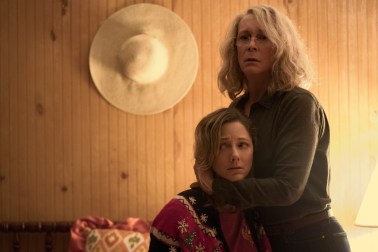
Finally, we come to the last era…well, probably not…but we finally come to the latest era in the Halloween franchise. For this iteration, David Gordon Green took the helm at co-writing and directing Halloween, released in 2018 (aka Halloween 2018). It was written for and released on the 40th anniversary of the release of the original film directed by John Carpenter. In it, Jamie Lee Curtis returns as Laurie Strode, a woman who is faced with the reality that Michael is on the loose again.

This film was envisioned to be a direct sequel to the original film. John Carpenter signed on to be an executive producer and also cowrote the soundtrack with his son. The truth is that Carpenter wasn’t happy with the direction the Halloween films had taken following his exit from the films back in 1982. He signed on to contribute to making the scariest sequel of them all and to recalibrate the series, putting it back on track with the oritinal intent.

You guessed it, that means that this iteration of Michael Myers was much more like the original. He was the walking embodiment of evil that has no reason, let alone moral justification, for what he’s doing. People fear what they don’t understand or know, and Carpenter (as well as David Gordon Green) understood that. To make Michael horrifying again, he had to be brought back to that realm of the mysterious. Why is Michael doing what he’s doing? Simple…he’s evil. There need not be any other reason but that.

With that said, this particular film also delves into the horrific impact that evil can have on its victims. Forty years aater the original film, Laurie strode is living alone in the woods, estranged from her family. Following the events of 1978, Laurie never fully recovered. She had a daughter, but ended up having the daughter taken away by Child Services. Why? Because she turned her entire house into an armed compound and trained her daughter to shoot to kill. The fear of one night forty years ago, had clearly overtaken her life.

To make matters worse, her daughter hates her and thinks she is completely insane, to the point where she is avoiding inviting her mom to dinner to celebrate. The relationship with her granddaughter is also strained, because of the the granddaughter’s mother has on her. She wants a relationship with her grandmom and does not understand why grandma cannot just let Michael go.

Of course, we all know that Michael escapes…AGAIN…and comes to where Laurie and her family are living. On Halloween night, her family realizes that Laurie’s fears were quite real and, those who survive, are quite thankful for her readiness, without spoiling anything. What I love about this film is that it totally takes a look at victims of horrific trauma. It shows us what being a survivor is all about and the horror that unfolds in their life well beyond the actual events that triggered it.

Plenty of people suffer from PTSD and other trauma related illnesses. When we commonly think of PTSD, we think of veterans who served in the military; however, that is one of many groups of people who suffer PTSD. Rape victims, bully victims, car accident victims, police officers, first responders, pastors, and plenty of others can experience PTSD from their own trauma or from experiencing the trauma of others.

Sadly, the church has caused PTSD in others, and I don’t mean just in the sexual abuse cases. I mean that there are a whole host of people who no longer attend church because they no longer view it as a safe place. Perhaps they were burned by people who saw themselves as better or were too selfish to consider another’s feelings. Perhaps they were rejected or treated differently because of how they dressed or whatnot. As Christians, we are being challenged by God to pay attention how we treat people and to avoid being a PTSD inducing people. Let us test ourselves, continually, to make sure we are bringing people to Christ…NOT crisis.

THOUGHT OF THE DAY
As much as we can spot evil in others, we had better be doubly quick to spot it in ourselves.

PRAY
Lord, use Scripture and other means to show me how I need to change for the glory of the Kingdom. With your help, all things are possible. Amen.

REVISITED: The Face of Evil, part 3

Read Romans 12:19-21

ALSO IN SCRIPTURE
“
Stay alert! Watch out for your great enemy, the devil. He prowls around like a roaring lion, looking for someone to devour. (1 Peter 5:8 NLT).”

Continuing on with the Halloween Franchise, we come up to a whole knew era of the Michael Myers Saga, where he gets a fresh new look from an metal icon turned film director, Rob Zombie. As was mentioned previously, Halloween was based on the film Psycho by Alfred Hitchcock, based off of the novel of the same name by Robert Bloch. In that film, we follow Norman Bates, a deranged, mentally ill man who murdered his mother and assumed her identity. It was scary, and Norman did monstrous things; however, you can’t help but pity him because he cannot help himself.

In Halloween, John Carpenter removes the sympathetic side of the killer out. The film starts with what we believe to be a human being…a six year old boy. We then find out that all humanity has left that little boy as he brutally murders his sister. When he finallyreturns to Haddonfield fifteen years later following an escape from a Mental Health facility, he is no longer a “human being.” Rather, he is a “shape”. The mask he wears is a ghostly shape of a face, and he lingers in the dark, awaiting for someone to pass by him in the shadows. In the original 1978 film, and subsequent sequels, Michael Myers is a rage-filled, unrelenting killing machine with no soul, no moral compass, and no awareness of self even. He is evil incarnate.

Rob Zombie, on the other hand, rebooted the original and took it into a different realm. Instead of dismissing the notion that evil is an evolution, Zombie challenges our understanding of what is evil and how it develops. In his film, we see a young Michael Myers, who is ten years old in this version. We see him at first playing with a rat and then we pan downstairs to see his mom ccoking dinner for her husband and kids. You can tell that they are a lower income, working class, and somewhat dysfunctional family.

When we see young Michael again, he’s washing blood off of his hands and a sharp instrument. He had killed the rat. Clearly, this young child is mentally ill. As we learn more about his home and school environment, it becomes clear that Michael’s behavior is a result of surviving abuse and neglect. His step father is abusive and his mother, who is also an exotic dancer, does her best, but that is not nearly enough for her children. Alcholism, sexual debauchery, and abuse exist in the Myers house.

At school, Michael is bullied and is constantly getting into trouble for writing and drawing distrubing things. The point is, the first third of the film were spent establishing Michael’s back story. The second third of the film is spent showing an adult Michael in the hospital as an adult, his eventual escape and his return to Haddonfield, the final third fo the film is spent the usual way, people running for their lives, blood, guts, mayhem and, eventually, Michael is defeated…but not really. There’s always a sequel, and there was a sequel for Zombie’s film.

In this, Rob Zombie is taking us beyond just sympathizing with a sick person and he is taking us beyond seeing evil as just this unpreventable, unstoppable force that we could never participate in or become; rather, Zombie is reminding us that, while evil does exist, human evil does not exist in a vacuum. Things aren’t always so black & white and, frankly, evil begets more evil. Had Michael grown up in a functional, loving, nurturing environment, his mental illness might not have taken the violent turn it did; what’s more, the household he lived in was so eroded by sin that evil was the natural result…and once evil is unleashed, it becomes a nearly unstoppable force that MUST be eradicated.

This should challenge us to not only avoid being so quick to make judgments, but it also should challenge us to really reflect on the ways we might be contributing to the sin and evil in the world. That is not to say that such mindfulness will result in nobody slipping through the cracks, but it would help us to ensure as few do as possible. Let us be a people who not only avoid being overcome by evil, but overcome evil with good!

THOUGHT OF THE DAY
Let’s reverse EVIL and by turning to God and beginning to trust him to help us LIVE the lives we were created to live.

PRAYER
Lord, help me to avoid evil but also help me to confront and resist it when it presents itself. Give me the courage and the strength. Amen.

REVISITED: Afraid of the Dark

Read John 1:1-18

ALSO IN SCRIPTURE
“Peace I leave with you; my peace I give to you. I do not give to you as the world gives. Do not let your hearts be troubled, and do not let them be afraid.” (John 14:27)

The night was dense, thickened by the looming darkness that fell swiftly over the land. A fog had rolled in off of the sea that night, a mist of death that shrouded the land like a linen that covers a grayish dead corpse from passers by.  The air was cut thin by an uneasy feeling, a horrid sense of despair that crept in one’s bosom and suffocated away the life.

There in the distance, I could make out a shape through the fog. I squinted as if to focus in and, the more focused I became, I began to realize that the shape was the body of my friend Lucy. Her figure was lying still on top of a marble bench in the cemetery outside of the abbey. A called out to her in hopes that she would hear me; however, she lay there motionless as if she were made of marble herself.

At the sound of my voice I noticed movement. Directly behind Lucy’s motionless body loomed a shadowy figure. It was hunched over her like a vulture that has come to eat the flesh of its prey. What looked like its head raised up and I could see, cutting through the thickened veil of mist, two beady, red orbs illuminating a path straight toward me. Terror overwhelmed me as I realized that its eyes, its terrible red eyes were fixed on me. It was at that moment that I felt the blood within me grow icy cold with the fear of death.

The scene above is one that is forever etched into my mind. It is my representation of a scene that I read in Bram Stoker’s Dracula, where Mina follows a sleepwalking Lucy out to the chapel at Whitby and sees, for the first time, the shadowy monster we all have come to know as Count Dracula. There are lots of memorable moments in that book, and the truth be told that it is my favorite novel; however, there is no other scene in the book that stands so horrifying in my mind that that very scene.

What is it that makes us so afraid of the dark and of darkness? Is it that our sight and our senses are limited? Is it that what lies beyond our sight is unknown to us and, as we all know, we fear what is unknown? The fact of the matter is that, whether it be day or night, there is much to fear in this world. Evil exists, and its monstrous presence in this world can be experienced even in the seemingly safest of places. In fact, don’t let the light and your senses decieve you. You are no more guaranteed safety in the light of day than you are in the dark of night.  We live in a world where cruelty, depravity and hopelessness seem to rule.

Yet, we are not without hope for we know that evil does not rule. We know that God sent true light into the world, the light of life, and that life resides in each and everyone of us. We can give into our fears and close out the light of God, or we can open our hearts to that light and let it transform us into beacons of hope, healing and wholeness for the rest of the world. In Jesus of Nazareth we see such a light, in Jesus Christ we see the hope of God carried out in humanity and we see the frailty of evil.

Do not let your fears conquer you. Trust that the true light of God is within you and shine it out for the world to see. Live as Christ did in this world. Love God by unconditionally loving others. Remove your fear and your cynicism and be a sanctuary of hope, healing an wholeness for the people around you who desperately need it. Shine that light no matter how the world reacts. Know that not even death can stop that light from shining within you for it is the light of Christ who conquered death.

THOUGHT OF THE DAY
“What is needed, rather than running away or controlling or suppressing or any other resistance, is understanding fear; that means, watch it, learn about it, come directly into contact with it. We are to learn about fear, not how to escape from it.” – Jiddu Krishnamurti

PRAYER
Lord, help me to conquer my fear. Fill me with your light and through me, bring hope, healing and wholeness to those who need it. Amen.

REVISITED: No One Can Judge

Read Romans 7:14-25

ALSO IN SCRIPTURE

“Do not judge others, and you will not be judged.” (Matthew 7:1, NLT)

Annex - Lugosi, Bela (Dracula)_05Every year, around this time, I read Bram Stoker’s Dracula, which is a tradition I have carried on since I was in high school. I absolutely love that tale, which is ultimately a tale about HOPE in the midst of darkness. There is one scene in the book that is absolutely striking to me. Mina Harker had recently been bitten by Count Dracula and, to make matters worse, had drank some of his blood. As we find out, this fuses Mina to him and begins to make her one of his. At one point, upon finding out that she drank Dracula’s blood (as she was in a trance when she did it), she cried out, “Unclean, unclean, God help me, I’m unclean!”

One can only imagine the absolute horror that Mina was going through. She had lived her life in a manner that was pure, always priding herself in her manners and behavior. She was a loyal person and loved her husband dearly, yet now she was tainted by this monster’s blood. She is absolutely revolted by the Count and horrified by what he as done to her; however, because she is spiritually bound to him, and as she begins to watch her humanity slowly fade away, she comes to a realization.

Looking up at her husband Jonathan, she asks that if she becomes like the count that he will put an end to her and put her soul at peace so that she may be with God. But her plea doesn’t end there. She also begs that he find the count and put an end to the monster so that the man trapped inside may find peace as well. Whoa! It is almost unfathomable for her husband Jonathan, but she makes him agree. He cannot understand how she could have even the remotest bit of sympathy for this savage beast, this wretched demon, this accursed vampire.

In Romans, Paul spent a good amount of time writing about the self-perpetuating cycle of sin. We know that certain things are good and often gravitate away from them. Conversely, we know that certain things are not good or healthy and yet we find ourselves doing those things anyway. No matter how hard we try, we often find ourselves stuck in the mire of our sins.

Paul knew, just as Mina came to realize, that there is a bit of monster in us all. We all let certain things get the better of us. We all are, to one extent or another, controlled by the negative things we allow into our lives. Perhaps some do more than others, but we all get caught up in things that God would otherwise wish to set us free from. Yet, we also tend to look at others as if they are worse than we are and, like Jonathan, we often get too caught up in our own self-righteousness to see that we are really in the same boat as the ones we judge.

Rather than being in the prison of our own judgements, we are called by God to be humble and to see the humanity in others, including ourselves. Even though we may not agree with the actions that people take, and even though we might even be forced to act against the evils that people perpetrate, we are still called to see the child of God beneath the sins that entrap them. We are all children of God, loved by God, and God wishes to free us all from our sins…in particular, the sin of judgment. All we have to do is be humble and let God guide us from the darkness of our judgments to the light of God’s unconditional love and grace.

THOUGHT OF THE DAY

“The least amount of judging we can do the better off we are.” – Michael J. Fox

PRAYER

Lord, humble me so that I might not judge others. Open my eyes and my heart to your mercy, your love, and your grace. Amen.